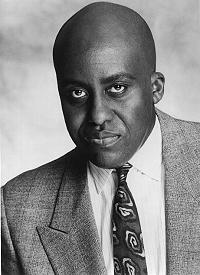
Bill Duke
Bill Duke
Bill Duke: I try to support homeless organizations that have an agenda that enables people to fend for themselves. So called homeless people are people. There's nothing indigenous or generic about them that puts them on the street except lack of opportunity--the slings and arrows of outrageous fortune in our society. I support the St. Joseph Center, for example, which not only feeds people and has a shelter, but treats people with great dignity. They have a 57% success rate with the people that come in. They give all kinds of counseling for battered women and children.
They also train people for the workplace. It's charitable in the truest sense of the word in that you are giving people the ability to fend for themselves. With that in mind, I'm trying to put together some support for an organization in the Bronx called The Willow Opportunity Center. I believe it works in the same spirit as the St. Joseph's Center. Not that all these people are homeless, but they're looking for a way of surviving in the technological age. Instead of preaching in a condescending way, The Willow Opportunity Center gives people actual tools and skills of survival in this new information age. This is something I think we should be doing.
A lot of the people who go through these centers have been failed by our society: educational institutions that really train people for an industrial age that has past us by--by at least 75 years. It is not preparing them for the information age that is upon us. People can't survive. It's not all the time due to the fact that they're lazy, but because they lack the training or the opportunities that are necessary for employment in this area.
LD: I wanted to ask you about your book, Black Light: The African American Hero.
BD: It's an attempt to chronicle, in a synoptic form, contributions that African Americans have made over the last 100 years in this nation. Not only athletes and entertainers but teachers, doctors, lawyers, inventors, city planners, politicians--all kinds of people that have contributed not only to the African American culture but to the American culture and fabric. Many times when you see minorities depicted in either the news or in popular media, we are depicted in a negative way, as though negative stereotypes are indicative as to who we are as a people. I wanted to balance the scales and say that those images are a very small portion of our society. The majority of African Americans are hard working people that have contributed a lot to their families and the nation overall. In this book there are short, synoptic kinds of portraits with pictures that give you an idea of that.
LD: When you were growing up, who encouraged you, saw your strengths?
BD: I think there are many. Most of them are my family: my mother and father, uncles and aunts. They were role models to me. My uncles, for example, none of them had a high school education, yet they didn't work for anybody. They had their own business. They weren't fancy--a cab business, or driving a school bus for kids; they cleaned office buildings or had garbage businesses. They were proud of it because they were their own boss and it was done without the advantage of a formal education. They were streetwise and survivors and very proud people. They handed that legacy down to my sister and me. I'm very happy to say that I think we've received a lot of that. We still have a long way to go but they were our heroes.
LD: When you were young, which came first in your mind, writing, acting, directing?
BD: I started off actually as a writer because I was an introvert. I was very large and tall and looked very big compared to the other kids, kind of gawky. So I was a very big kid and didn't have any friends. My thoughts and feelings...I had no one to express them to so I wrote them down. Luckily for me, I got a break in high school.
I was writing poetry at a very early age. One day I was in my English class and Mrs. Walker, a teacher of mine, came up to my desk because I wasn't paying attention. I was writing a poem or two. I had a poetry book and she took it away from me. I was very hurt. She wanted to show me that I should pay attention in her class. I said, "I'm sorry. Please give me my book back." She wouldn't. Every day for two weeks I would ask her and she kept saying she'd give it back at the end of the semester. I waited and waited. At the end of the semester she came into the classroom with a book of the National Poetry Contest. She had entered my poems and I had won first place. That was wonderful for her to do. Wonderful encouragement.
LD: What do you like about acting?
BD: Acting for me is an opportunity to really live out a number of lives. There are very few things that you do as an actor that are not part of your psyche or part of your being on some level. To be able to portray those different aspects of yourself is a bit freeing in a lot of ways. And to do it well is very rewarding. I've been very fortunate in that I've been able to get a certain freedom. Also, I'm basically an introverted person and it's a way of me "acting out" to a certain extent. Being many different kinds of things that I think I don't have the personal courage to be in my personal life. On stage or in front of a camera, you can be those things without pulling any punches.
LD: Do you have a favorite role?
BD: I think my favorite role was playing the father on a television series called Palmers Town USA which was on CBS for a couple seasons in the '80s. It was diverse. This guy had a many faceted personality. He was a father, husband and community leader but also had a dark side so you saw his humanity. I got a chance to play many different characters in one.
LD: The name of your production company....
BD: Yagya? It's a Sanskrit word meaning "work done in the name of evolution."
LD: What moved you to name it that?
BD: Well, evolution is something we all should be involved in, you know. We're evolving all the time. I teach Transcendental Meditation. I've been meditating since 1972. A lot of the manuscripts are written in Sanskrit. The word "Yagya" is something I came across in Hindu scriptures and I wanted to name my company something I believed in.
LD: How do you relax, feel peaceful?
BD: Meditation, Yoga, reading and music. I also do a little bit of martial arts. Trying to get more into that.
LD: What gives you hope and motivation?
BD: Oh, a number of things. I think one, children. Children are really inspiring to me. Two, I would say, I know for a fact that there are polarities in life and whatever you see negatively stated, there is an opposite balance of positivity on the other side. There are other things occurring that are not well publicized on the positive side of the ledger in our society. Unfortunately, we don't see it. That's why what you're doing is so courageous and wonderful and inspiring--reporting the light side of things and not only focusing on the darkness.